Kitchen Fire Damage Restoration, Nationwide
Cleanup for cooking fires: grease and protein residue, cabinets, appliances and smoke that spread to the rest of the home.
Call toll free now
Tell the operator your city, what happened and whether the fire department has cleared the building. You will be connected with a local provider that covers your area.
(833) 917-4160Fire damage? Call toll free now
- Give your city and ZIP code
- Say what happened and whether the fire is out
- Ask the company about its license and insurance
Quick answer
Cooking is the leading cause of home fires in the United States. A small kitchen fire can still spread smoke and greasy residue through the whole house. Call (833) 917-4160 to reach a local company that can clean cabinets, appliances and the rest of the home.
Why kitchen fires are so common
NFPA research covering 2013 to 2017 found that cooking caused about 173,200 of the roughly 354,400 home structure fires reported each year, which is close to half. Unattended cooking, grease buildup, towels near burners and cooking oils that overheat are common starting points. Many of these fires never leave the kitchen, but the smoke and residue do.
What a kitchen fire leaves behind
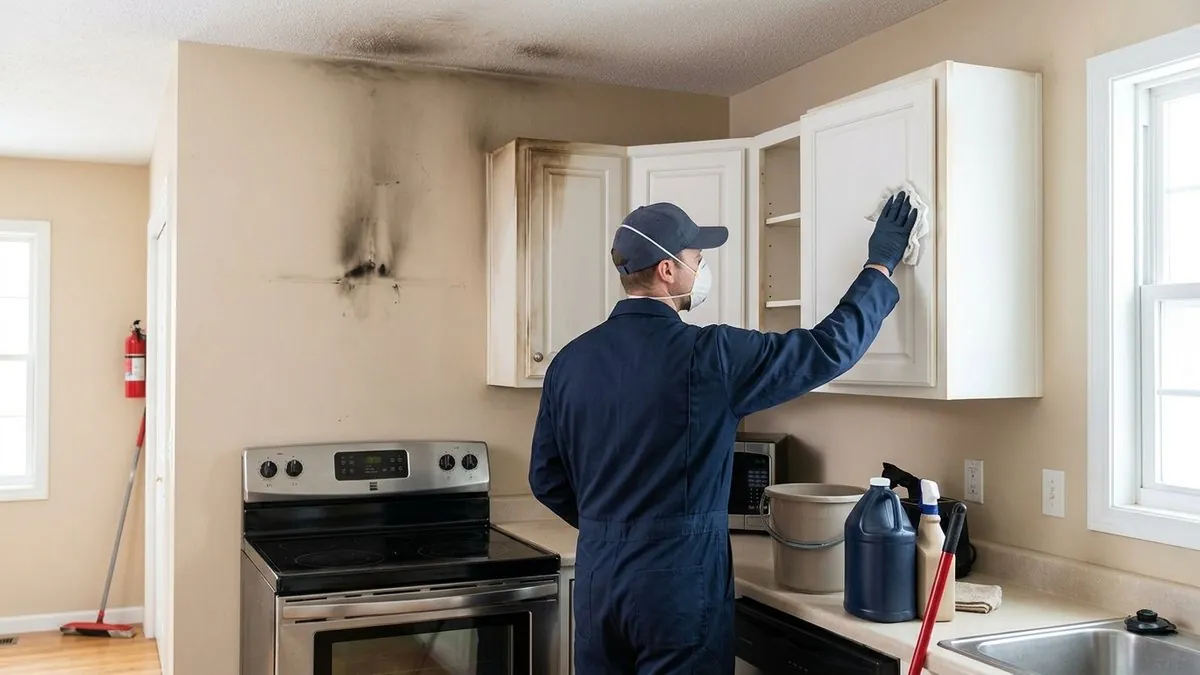
- Protein residue from burned food. It can be nearly invisible, discolors paint and varnish and carries a strong odor.
- Grease film on walls, ceiling, hood and cabinet faces.
- Soot and smoke that follow air currents into hallways and bedrooms.
- Extinguisher powder if a dry chemical extinguisher was used. It can be corrosive to electronics and metal and should be cleaned promptly.
- Heat damage to cabinets, countertops, flooring and appliances.
What restoration usually covers
- Assessment of fire, heat and smoke spread beyond the kitchen.
- Cleaning or removing affected cabinets, countertops and backsplashes.
- Degreasing walls and ceilings and cleaning the range hood and exhaust path.
- Appliance evaluation, since some may be cleaned and others replaced.
- Odor treatment across connected rooms.
- Repairs such as drywall, paint, cabinets and flooring if the fire damaged the structure.
Food, dishes and small items
Food that was exposed to heat, smoke or extinguisher chemicals is generally not safe to eat. The U.S. Department of Agriculture advises throwing out food that may have been contaminated, and that includes items in cartons and packaging that can absorb fumes. Dishes and cookware can often be washed and sanitized, but porous items such as wooden utensils and plastic containers may need replacement.
Find help in your state
Popular cities
Frequently asked questions
Can kitchen cabinets be saved after a fire?
Often, if they are hard surfaced and the damage is smoke or grease only. Cabinets with heat warping, deep char or soaked particleboard are usually replaced.
Why does my whole house smell after a small kitchen fire?
Smoke and grease particles travel through the air and settle in porous materials throughout the house. Cleaning only the kitchen leaves the source of the odor in other rooms.
Do I need to replace my stove?
Not always. A technician or appliance repair professional should check it for heat damage, corrosion and electrical or gas safety before you use it again.
Does my insurance cover a kitchen fire?
Standard homeowners and renters policies generally cover fire damage and smoke damage, subject to deductibles and limits. Ask your insurer how smoke damage in other rooms is handled.
Need this service now?
Call toll free to be connected with an independent local company.